Welding Techniques and Test Methods in Geomembrane Applications
Engineering precision and fundamental principles in geomembrane joining technologies are directly related to the field success of leak‑proof projects as much as the quality of the geomembrane sheets used. In geomembrane applications, the welding process is the transformation of two separate polymer layers into a single body at the molecular level under heat and pressure.
This process is not merely a simple adhesive operation; it aims to create a resistance point higher than the material’s own strength. According to engineering standards, a properly executed weld line should fail before the base material when subjected to a tensile test.
The most basic principle we emphasize in our projects at MZ Trade is the optimization of the welding technology according to the field conditions, material thickness, and the geometric structure of the project. Different polymer structures such as high‑density polyethylene (HDPE) or polyvinyl chloride (PVC) have different melting points and flow indices, so specific welding parameters must be defined for each material.
The speed of the welding machine, the application temperature, and the force applied by the pressure wheels create the “sacayak” that determines the continuity of the seal. Disruption of this balance either causes the material to burn and lose its properties or creates leak paths due to insufficient fusion.
Advantages of Double‑Stitch Fusion Welding and Automatic Robotic Systems Large‑scale waste storage sites, mining ponds, and extensive irrigation ponds most commonly and reliably use the double‑stitch fusion weld. Automatic welding robots that operate with hot‑wedge technology press two geomembrane panels together, heating and joining them simultaneously along two parallel lines.
The most strategic feature of this method is the air channel left between the two weld lines. This channel provides a natural arrangement for post‑assembly quality control tests.
Automatic robots minimize operator errors, moving at a constant speed and temperature; this ensures homogeneous weld quality over thousands of square meters. The advanced welding robots used on MZ Trade sites record instantaneous temperature and speed data on digital displays, providing data for the project documentation process.
Fusion welding is the fastest method for straight and wide surfaces. However, its success depends on panel cleanliness and precise adjustment of the bonding areas.
Surfaces containing dust, moisture, or oil residues will not fuse completely, so surface preparation before welding is the stage where professional teams spend the most time. Extrusion Welding with Detailed Solutions and Critical Joint Connections In tight spaces that automatic robots cannot enter, at pipe exits, corner turns, and patching areas, extrusion welding is employed using hand extruders.
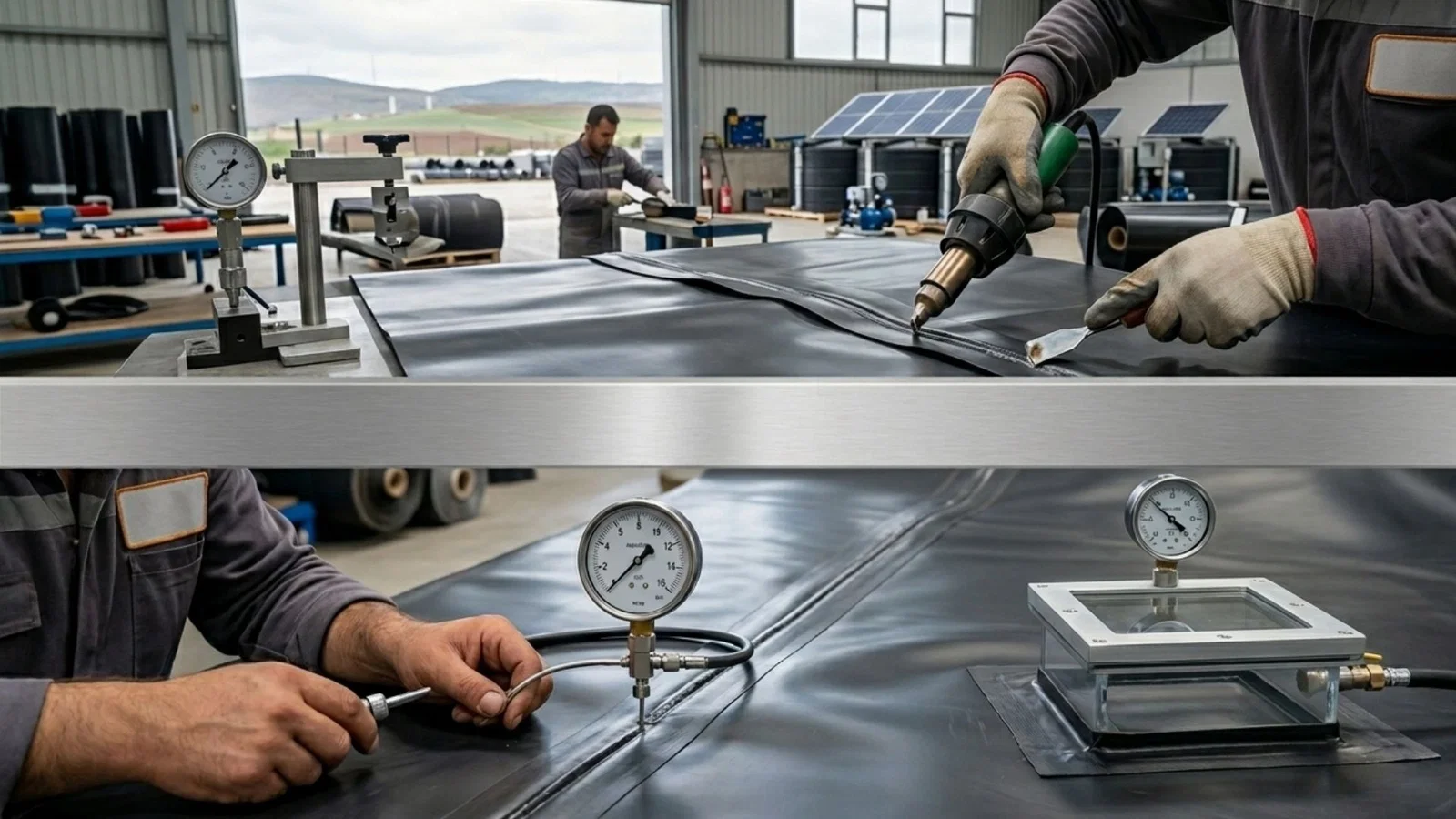
This method works by melting polyethylene welding wire inside the machine and applying it between and over the two surfaces, which have the same raw material properties as the main geomembrane. Although extrusion welding is slower than fusion welding, it plays a vital role in the seal of details.
The most critical step in this method is the pre‑roughening of the surface where the weld will be applied. Grinding the oxide layer with hand tools creates a much stronger bond between the melted polymer and the main body.
MZ Trade’s technical specifications specifically state that extrusion welding must be performed only by certified specialists because the process requires high manual skill and precise heat management. The seal of a pipe flange or reinforced concrete connection point must not be the weakest link in the field’s overall safety.
Extrusion welding is a technical art that turns these weak links into the strongest points of the project. Pre‑Weld Field Preparation and Management of Environmental Factors A perfect geomembrane weld requires more than a good machine and operator; the environmental conditions on site must also be controlled.
Wind, ambient temperature, and humidity are external factors that directly affect weld quality. In very cold weather, the geomembrane surface requires pre‑heating, while excessive heat can cause excessive expansion of the material, leading to bulges in the weld seams.
MZ Trade’s application protocols standardize pausing welding operations during rainy weather or high humidity. The surfaces to be welded must be dry, clean, and smooth to allow polymer chains to fully bond.
Additionally, the protective geotextile laid beneath the geomembrane must be wrinkle‑free to help the welding machine move smoothly along a straight line. In windy weather, securing panels with sandbags is essential to prevent them from flying and to keep dust out of the weld mouth.
This meticulous field preparation minimizes future repair and patching work, allowing the project to proceed according to schedule. Non‑Destructive Inspection of Double‑Stitch Welds with Air Pressure Testing After the application is completed, the first and most important quality control test is the air pressure test.
Air is pumped into the void between the two lines created by the double‑stitch fusion weld using special test needles at a specified pressure. The pressure value set by engineering standards typically ranges from 1.5 to 2.0 bar and is expected to remain constant for a certain period (usually 5 to 10 minutes).
If no drop in pressure is observed on the manometer, that weld line is confirmed to be fully leak‑proof and free of microscopic leak paths. MZ Trade’s quality control teams report each weld line with date, time, and pressure data added to the project file.
In cases where a pressure drop occurs, the location of the fault is found using a soapy water spray method or visual inspection, and the problematic area is immediately repaired and the test repeated. This non‑destructive test method is the project’s greatest safety insurance.
Vacuum Testing for the Safety of Extrusion Welds and Patches In extrusion welds where automatic fusion welding cannot be performed or an air channel cannot be created, leak inspection is carried out with a vacuum test. The vacuum test is performed using a transparent plexiglass box and a vacuum pump.
After a soapy water solution is applied to the area to be welded, the vacuum box is placed over it and the air inside is evacuated to create negative pressure. If there is a leak or pinhole in the weld line, the negative pressure causes the soapy water to form bubbles.
This visual evidence allows us to pinpoint the exact location of the leak. The vacuum test is the most effective method used to ensure the seal of complex details such as pipe exits and corner turns.
MZ Trade requires all manual welds on site to undergo 100 % vacuum testing, minimizing risks that could arise from human error. Each vacuum test is an integral part of the goal to create a leak‑free barrier throughout the project.
Destructive Tests and Laboratory Analysis of Weld Strength In addition to non‑destructive tests, destructive tests are performed at regular intervals by taking field samples to measure the mechanical strength of the weld. Geomembrane weld samples cut from different points on the site are pulled in two directions using field‑type tensile devices (tensiometers) to measure their break resistance.
Two main criteria are considered in these tests: peel strength and shear strength. For a test to be considered successful, the failure must occur in the base material, not in the weld line; this is called “Film Tear Bond.” If the weld separates from the material, it indicates that the welding parameters (heat, speed, or pressure) are incorrect, and all production for that day is scrutinized.
MZ Trade’s laboratory protocols require taking and reporting such samples every 150–200 meters of weld. These tests prove that the geomembrane barrier not only retains water but also resists mechanical loads applied to it.
Spark Test and Electrical Leak Detection for Advanced Inspection In hazardous waste storage facilities and radioactive waste dams, even a tiny pinhole leak can cause major disasters. In such critical projects, in addition to conventional tests, electrical leak detection methods (Spark Test or Arc Test) are used.
In this test, a conductive layer (usually conductive geotextile or a special mesh) is placed beneath the geomembrane, and a high‑voltage brush is moved over the surface. If there is an invisible microscopic hole on the geomembrane, the electric current passes through it, creating a spark and triggering a loud signal from the device.
This method achieves 100 % success in detecting damage too small for conventional tests. MZ Trade’s advanced technology projects offer this inspection service as the highest‑level safety solution for investors seeking excellence in leak‑proofing.
Electrical tests mathematically prove that no damage remains on the geomembrane surface before project delivery. Professional Approach to Weld Defects and Repair Methods Errors detected during tests or physical damage occurring during field operations do not mean the geomembrane system has failed; on the contrary, the system can be restored to its original strength with proper repair methods.
Faulty weld areas are cut out and a circular or oval patch is placed over the area. Rounding the patch corners is a critical technical detail to prevent stress accumulation.
The patching process is applied to the cleaned and roughened surface using extrusion welding or hot‑air hand welding devices. Each repaired area must be re‑tested with a vacuum test, just like the main welds, to be approved.
MZ Trade specialists recommend not performing “patch on patch” and advise that each intervention be applied to a clean, new surface. When the repair process is managed meticulously, it does not reduce the lifespan or reliability of the geomembrane barrier; instead, it eliminates weak points.
Quality Control Documentation and Project Delivery Standards The final stage of a geomembrane application is the quality control file that compiles all field data. This file contains the certificates of the materials used, calibration documents of the welding machines, operator certificates, pressure test graphs for each weld line, vacuum test results, and destructive test reports.
It also must include a numbered map of each weld line on the “As‑Built” project. This documentation provides a reference point for potential issues that may arise during the facility’s operational life.
Comprehensive project files prepared by MZ Trade meet the highest standards accepted by official audit bodies and international insurance companies. Any unrecorded operation represents uncertainty and risk in the future.
Therefore, data discipline is as essential as technical excellence in modern geomembrane applications. Continuous Training and Technology Integration in Leak‑Proofing Technology Geomembrane welding technologies are becoming smarter each year.
GPS‑integrated welding robots, pressure gauges that transmit real‑time data, and AI‑supported leak analysis software are shaping the industry’s future. At MZ Trade, we equip our field teams with the latest technologies and keep their technical competence up to date with periodic training.
Leak‑proofing is not just a material supply; it is the perfect combination of engineering knowledge and field practice. Structures built with proper welding techniques and uncompromising test methods are the most tangible proof of our mission to protect nature.
Every successful project is a big step toward preserving clean water sources and building a safe future. Technological discipline and a quality‑focused approach turn geomembrane barriers into an unshakable environmental shield.