Use of Geomembrane in Foundation Grouting and Curtain Wall Insulation
Modern Foundations: The Static Importance of Base Waterproofing and Curtain Wall Insulation In civil engineering, the long life of a structure is not only dependent on the quality of the concrete used or the amount of reinforcement; it is directly related to how the structure is protected from water and moisture from the foundation upwards. Base waterproofing is the most critical protection stage that isolates the parts of the structure that remain underground like a sheath from external influences.
Groundwater, seepage water, and soil moisture penetrate the porous concrete, causing reinforcement corrosion and gradually weakening the structural system from within. Geomembrane technology, unlike traditional sliding-based insulation materials, creates an impenetrable shield at the foundations with its high elasticity and mechanical resistance.
The foundation insulation solutions we offer at MZ Ticaret eliminate the hydrostatic pressure and chemical effects that the structure will be exposed to throughout its life, providing a safe living space. A mistake in foundation insulation leads to repair processes that are impossible to correct in later years and are extremely costly.
Therefore, selecting a geomembrane in waterproofing systems is the biggest investment made in the future of the structure. Resistance of Geomembranes to Groundwater and Hydrostatic Pressure The foundations of buildings, especially in areas with high groundwater levels, are constantly under water pressure.
Hydrostatic pressure seeks to penetrate the weakest point of the insulation layer. Traditional bituminous membranes or sliding insulations can lose their impermeability over time due to cracks or additional joints formed by the settling of concrete.
However, HDPE and LDPE geomembranes, thanks to their high tear stretch and flexibility, dampen structural movements and maintain integrity. The most important point emphasized in MZ Ticaret’s technical specifications is that the geomembrane provides maximum protection even under water pressure through full adhesion to the concrete or free‑flow methods.
The polymeric barrier created between water and concrete completely blocks the passage of ions that disrupt the chemical structure of concrete, such as chloride and sulfate. A properly designed waterproofing system places the building’s foundation as if it were in a dry pool, minimizing all structural risks caused by moisture.
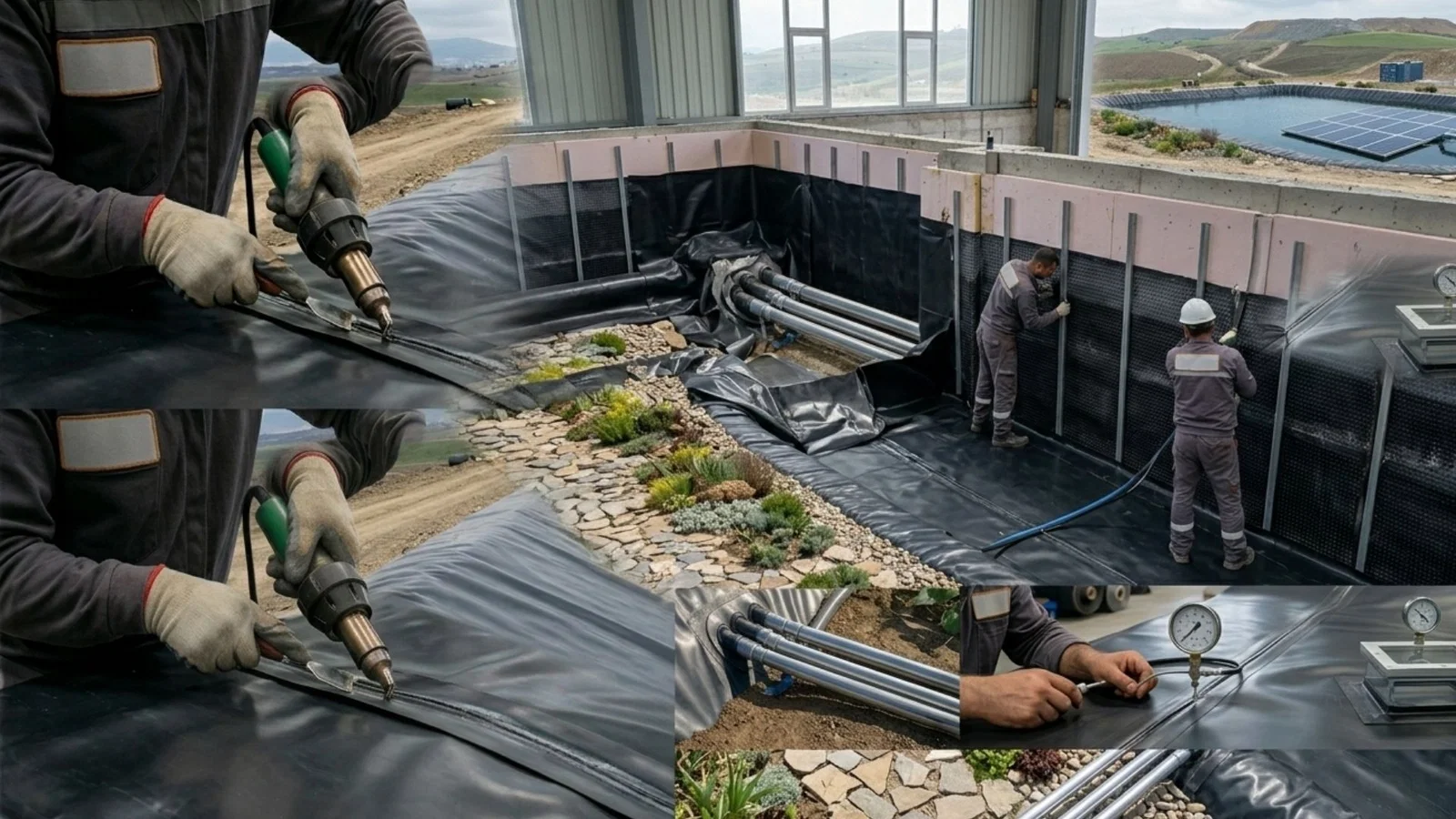
Application Techniques in Base Waterproofing: Free‑Flow and Adhesive Systems When insulating the foundation with a geomembrane, different application techniques are chosen based on the ground conditions and foundation type. In radial foundations, the free‑flow method is usually used; in this method, geomembrane panels are laid on the prepared grobeton surface before concrete pouring and joined at the joints with thermal welding robots.
In curtain walls, the geomembrane must be mechanically fixed to the surface after concrete pouring or integrated with special adhesive systems. MZ Ticaret’s application teams keep seam quality and continuous impermeability at the highest level in both methods.
In the free‑flow method, protective geotextiles of appropriate weight must be used to allow the material to conform to the ground’s roughness and to prevent damage during concrete pouring. The success of the waterproofing system depends on the flawless integration of horizontal insulation under the foundation with vertical insulation in curtain walls.
These junctions are the most sensitive parts of the system and are joined into a single body by thermal fusion in expert hands. Curtain Wall Insulation: Integration of Geomembrane and Drainage Plate Curtain walls, which are vertical surfaces in contact with the ground, must be protected not only from water infiltration but also from lateral pressure exerted by the soil and the mechanical effects of backfill material.
Using a geomembrane in curtain wall insulation completely isolates the concrete from the outside world. However, to protect the insulation layer and to allow water to drain without accumulating on the insulation surface, bubble drainage plates must be applied on top of the geomembrane.
MZ Ticaret designs the curtain wall insulation projects as a whole, integrating the geomembrane and drainage plate. Drainage plates prevent damage to the geomembrane during backfilling while allowing water to quickly reach the drainage pipes beneath the foundation under the influence of gravity.
This reduces the water load on the insulation layer and doubles the system’s safety. Curtain wall insulation is an indispensable structural element for making basement floors habitable and for drying areas used as storage.
Local Insulation Details in Elevator Shafts and Riser Connections The most common mistakes in foundation insulation and the most frequent leaks occur in elevator shafts, plumbing galleries, and risers inside the foundation. These areas are below the general level of the foundation, making them the points where groundwater pressure is greatest.
Waterproofing elevator shafts from the inside or outside with a geomembrane keeps the lowest point of the building dry. MZ Ticaret uses extrusion welds and special sealing tapes to adapt the geomembrane perfectly to the reinforced concrete structure in these complex details.
Special flange systems used in pipe penetrations and mechanical plumbing connections prevent water from seeping behind the geomembrane. Solving these details is possible not only with material quality but also with extensive field experience and meticulous workmanship.
It should not be forgotten that a single unresolved pipe penetration in a system covering thousands of square meters can cause the entire system to fail and lead to basement flooding. Geomembrane Protection Measures on the Construction Site and Concrete Pouring Process After the insulation application is completed, the period until concrete is poured or backfilled is the most vulnerable time for the geomembrane.
The work of other disciplines on the site, the laying of reinforcement, and the use of vibrators pose a high risk of puncturing the geomembrane. MZ Ticaret recommends placing protective layers (protective concrete or high‑weight geotextiles) over the geomembrane as a standard procedure after application.
Rules that workers laying reinforcement must observe while working on the geomembrane and measures to prevent the sharp ends of the reinforcement from damaging the material are critical to the project’s success. During concrete pouring, the vibrator must not come into direct contact with the geomembrane, and the concrete must be poured from a height that does not damage the material.
Monitoring these processes ensures that the insulation is completed without hidden damage. After concrete is poured, the geomembrane becomes an integral part of the structure and begins its task that will last for decades.
Effects of Moisture and Humidity on Building Physics: Healthy Living Spaces Good foundation insulation not only keeps the building standing but also protects the health of its occupants. Capillary moisture rising from uninsulated foundations causes mold in walls, paint flaking, and unpleasant odors.
This creates an unhealthy indoor air environment that triggers respiratory diseases. Geomembrane barriers act as an air barrier that also prevents harmful gases such as radon from entering the building.
The waterproofing solutions offered by MZ Ticaret raise the comfort level of basement floors to a high level, allowing these areas to be used efficiently as offices, gyms, or living spaces. From a building physics perspective, a dry foundation positively affects the building’s thermal insulation performance because the thermal conductivity of wet concrete is much higher than that of dry concrete.
This translates into energy savings and a sustainable building operation. Testing and Leak‑Approval Protocols for Geomembrane Seams in Foundations and Curtain Walls The success of the geomembrane seams used in foundation and curtain wall insulation must be proven by technical tests beyond visual inspection.
MZ Ticaret inspects and approves every weld line performed on site with a pressure test or vacuum test. Vertical welds in curtain walls are the most demanding areas under gravity and backfill pressure.
The constant air pressure applied to the channel between double‑seam fusion welds proves that the line has become a single piece at the molecular level. Test reports prepared after the application are a quality certificate presented to building inspection agencies and property owners.
Insulation layers closed without these tests increase the responsibility and risk of future leaks. Technical discipline is the greatest guarantee of impermeability projects and allows errors to be caught and compensated during the construction phase.
HDPE Geomembrane Advantage in Chemically Aggressive Soils Some sites may contain high levels of sulfate, chloride, or organic acids due to proximity to industrial areas or poor soil characteristics. These chemicals attack the cement paste inside the concrete, disintegrating the concrete and leaving the reinforcement vulnerable.
HDPE geomembranes are among the few materials that show full resistance to almost all aggressive chemicals on Earth. The high‑density polyethylene solutions offered by MZ Ticaret protect the structure not only from water but also from these soil‑originated chemical attacks.
While bituminous or liquid‑based insulations dissolve over time under the influence of these chemicals, the geomembrane structure protects for decades. In this invisible underground battle, the strongest armor protecting the structure is a geomembrane layer with proven chemical resistance.
This feature makes geomembrane use mandatory in the foundations of industrial buildings and logistics centers. Economic Analysis: Initial Cost and Long‑Term Gains Applying base waterproofing with a geomembrane may appear somewhat higher in initial investment compared to sliding‑based insulations.
However, this cost difference is negligible within the total budget of the building. In contrast, the costs incurred for draining water from a leaking foundation, redoing drainage, and reinforcing the structure can reach up to ten times the original insulation cost.
MZ Ticaret provides investors not only with material sales but also with an analysis of the economic advantages that the project will offer throughout its life. A building with guaranteed impermeability preserves its sale value and reduces operating costs.
The presence of a professionally applied geomembrane waterproofing in building insurance processes positively influences insurance premiums and risk assessments. From a financial perspective, saving on foundation insulation means giving up the future value of the building.
Vision of Impermeability in Future Construction Standards With evolving construction technologies, concepts such as “Zero‑Energy Buildings” and “Sustainable Cities” are coming to the fore. The cornerstone of these buildings is a robust infrastructure completely isolated from the external environment.
In the future, smart sensors installed in building foundations will allow any change in the insulation layer to be monitored in real time. MZ Ticaret, as part of this vision, closely follows the digitization of impermeability technology and material development.
We continue to guide the construction sector with thinner yet stronger, faster‑to‑apply, and environmentally friendly geomembrane solutions. Building foundations are now made not only of concrete but also of engineering structures reinforced with advanced polymeric systems.
At the heart of this technological transformation, geomembrane remains the unwavering guardian of tomorrow’s safe and comfortable buildings.