Secondary (Secondary) Protection with Geomembrane in Industrial Facilities
Industrial Facilities Secondary Protection Concept and Engineering Requirements In modern industrial facilities, the storage of chemicals, fuels, and hazardous liquids is not only an operational process but also a multi-layered security discipline. Tanks, pipelines, and reactors, referred to as primary protection, no matter how robustly constructed, carry the risk of leaking due to corrosion, vibration, or material fatigue.
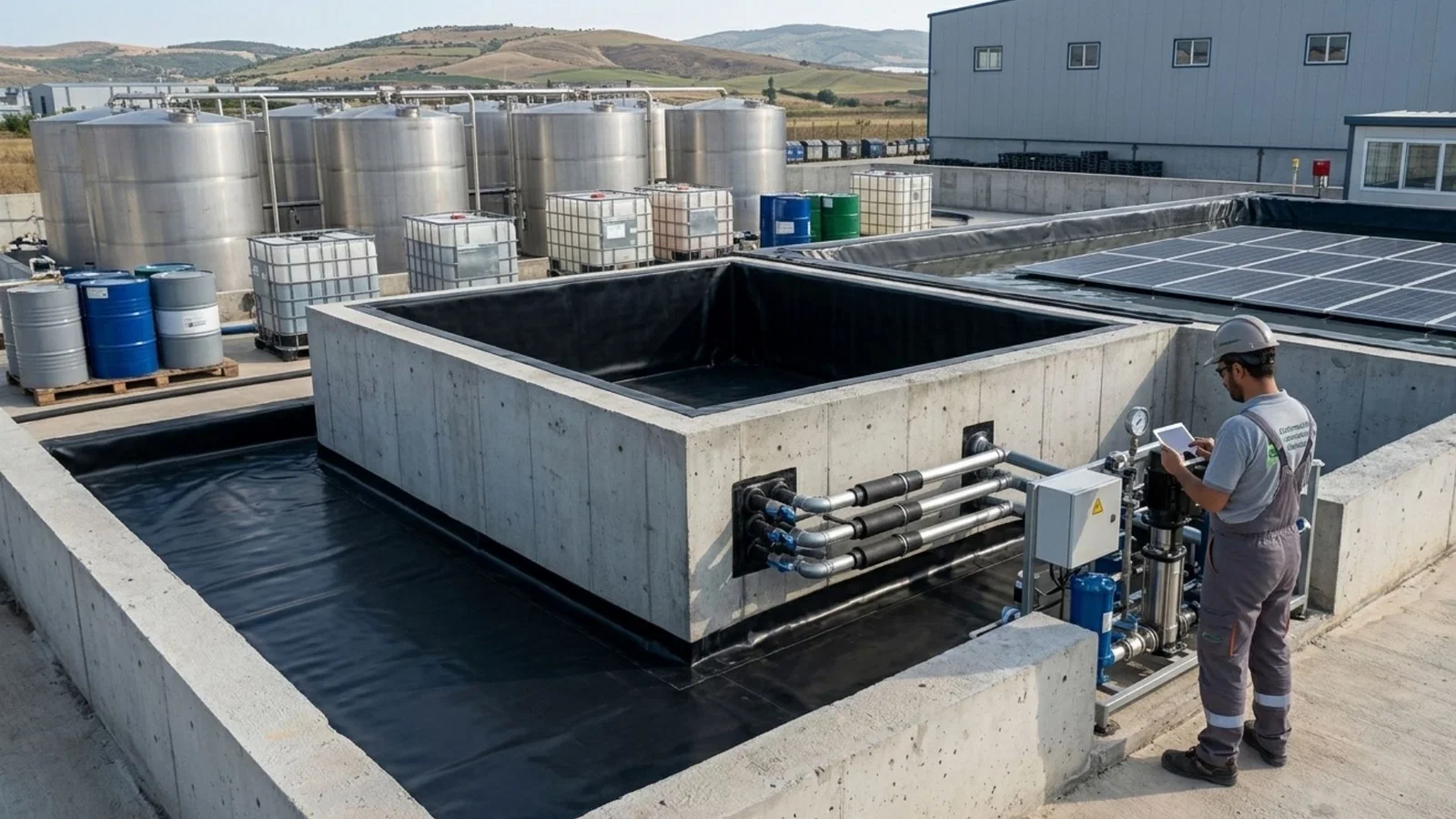
At this point, secondary or tertiary protection systems come into play, forming the last line of defense that contains any hazardous substance that may escape from the primary containment and prevents its spread to the environment. Geomembrane technology offers the most reliable, economical, and long‑lasting engineering solution for making these secondary containment pools (bunding) watertight.
While reinforced concrete structures tend to crack and leak over time, high‑elasticity geomembrane barriers create an impenetrable shield on the facility’s ground. The secondary protection solutions we provide at MZ Trade are optimized for the facility’s risk profile and the type of stored chemical, designed to ensure complete safety even in the toughest industrial scenarios.
Chemical Resistance and Barrier Selection in Hazardous Material Storage Areas Chemicals used in industrial facilities range from acidic solutions to basic liquids, hydrocarbons to aggressive solvents. Each of these substances exerts different molecular effects on the impermeable barrier.
When selecting a geomembrane for secondary protection, it is essential that the material does not swell, dissolve, or lose its mechanical properties upon contact with the stored chemical. HDPE geomembranes, thanks to their high crystalline structure, exhibit superior resistance to most acids and bases; in petroleum terminals or refineries, geomembranes with special alloyed formulations resistant to petroleum should be used.
If the primary tank is punctured, the spilled liquid can be collected in the secondary pool without contaminating groundwater and safely discharged only with an impeccable chemical barrier. MZ Trade’s technical teams analyze the appropriate resistance tables for each substance stored in your facility and determine the correct geomembrane type with the highest chemical compatibility.
This meticulous selection process is the most important strategic step that prevents environmental disasters in the event of an accident. Rehabilitation and Strengthening of Reinforced Concrete Tank Pools with Geomembranes In many older industrial facilities, secondary protection is attempted only through reinforced concrete pools.
However, due to its porous nature, concrete can absorb liquids, and microscopic cracks that develop over time can become leak paths. Covering the interior surfaces of existing concrete structures with geomembranes both extends the life of the old structure and brings the facility into full compliance with current environmental regulations.
During this application, the geomembrane is attached to the concrete with special fixation profiles or mechanical anchors and all seams are joined by thermal welding. When the rigid concrete structure is combined with the flexible barrier feature of the geomembrane, a hybrid system highly resistant to seismic movements or ground settling is achieved.
In the rehabilitation projects we carry out at MZ Trade, every stage—from preparing the concrete surface to conducting core tests—is completed quickly without disrupting the facility’s operations. This method is far less costly and far more reliable in terms of watertightness than building a brand‑new reinforced concrete structure.
Sealing Standards for Fuel Terminals and Refineries Refineries and fuel storage facilities are among the highest‑risk groups for environmental pollution. The protective walls (dike walls) surrounding the massive storage tanks at these facilities must be sealed with geomembranes to prevent leaking fuel from reaching the soil.
Standard polyethylene may lose its properties over time when in contact with fuel, so high‑performance LLDPE or HDPE geomembranes that are fuel‑resistant should be used in these areas. Geomembrane layers integrated with leak detection systems installed under tank bottoms can detect even the smallest leak instantly.
MZ Trade supplies geomembrane products with international certifications that maintain performance even after many years of hydrocarbon exposure, meeting the stringent safety standards of the energy sector. A safe fuel terminal must be fully equipped not only against fire but also against invisible ground leaks; the heart of that equipment is a high‑quality geomembrane barrier.
Secondary Protection Pools in Industrial Wastewater Treatment Facilities Wastewater from industrial plants can be highly corrosive and hazardous to the environment until it reaches the treatment stage. The balancing pools, settling tanks, and sludge drying beds where this water is collected must be protected at the highest level of watertightness.
Every unit of the facility, including chemical dosing areas used in the treatment process, should be covered with geomembranes. Using geomembranes as the inner lining of reinforced concrete tanks prevents the concrete from disintegrating due to sulfate and acid attacks, preserving the structure’s static life.
The geomembrane systems we apply in treatment plants at MZ Trade both prevent the escape of water and stop groundwater from entering the tanks and disrupting treatment capacity. This dual protection increases the plant’s efficiency while guaranteeing environmental compliance.
When selecting geomembranes for treatment plants, the water temperature and chemical concentrations are calculated in detail to determine material thickness and type. Integration of Geomembrane Under‑Leak Detection and Monitoring Systems The greatest innovation in modernizing secondary protection systems is the placement of sensors and drainage layers beneath the geomembrane layer.
With these systems, when a leak occurs in the primary tank, the leaking liquid accumulates on the geomembrane barrier and immediately alerts the operator via sensors. Geomembrane barriers integrated with electrical leak detection methods can detect even millimetric holes, minimizing intervention time.
MZ Trade’s integrated solutions for smart industrial facilities transform watertightness from a passive barrier into an active security monitoring system. Leak detection systems strengthen the operator’s control in environmental audits and protect against potential pollution compensation and reputation loss.
The intertwining of technology and watertightness has become an operational necessity, not a luxury, for modern industrial enterprises aiming for a zero‑leakage goal. The precision in installing these systems is the most fundamental element that determines the overall reliability of the project.
Local Geomembrane Barriers in Pipeline Lines and Valve Rooms A facility’s risk of leakage is not limited to its main tanks; the pipeline lines and valve rooms that transport liquid between tanks also pose a risk. Drainage trenches running beneath pipeline lines allow liquid to flow to a collection point without spreading to the environment in the event of a pipe rupture.
Valve rooms and pump stations, where mechanical equipment is dense, are the most vulnerable to leaks due to vibration. Covering the base and side walls of these areas with geomembranes is critical for maintaining industrial hygiene and preventing ground contamination.
MZ Trade uses high‑handcrafting and extrusion‑welding techniques to make every valve outlet and pipe passage watertight in these narrow and complex spaces. Local protection barriers are an integral part of the facility’s overall watertightness strategy, preventing small leaks from turning into major environmental disasters.
Each pipe connection is kept under control by the safety shield created with geomembranes. Installation Quality and Welding Safety in Secondary Protection Systems Applying geomembranes in industrial facilities requires far more technical precision than a standard pond lining.
The numerous columns, foundation footings, and pipe outlets inside the facility necessitate flawless integration of the geomembrane with these details. Each welding line must pass vacuum and air‑pressure tests successfully to ensure system integrity.
MZ Trade’s field engineers work under a “zero‑error” principle, guaranteeing watertightness even in the most demanding corner details. Welding robot temperature settings are optimized in real time based on the facility’s ambient temperature and the chemical composition of the material.
In facilities where flammable or explosive substances are present, the safety of the electrical equipment used during welding and full compliance with field operational procedures are our top priority. A professional installation process is the most critical stage that transforms the theoretical performance of a geomembrane barrier into a real protective shield on site.
Ground Isolation in Chemical Loading and Unloading Stations Loading and unloading areas, where logistics processes are most intensive, are the points with the highest risk of spills and splashes. The floor of the platforms where tankers or wagons are filled must be designed to direct any spilled chemical immediately into discharge channels and isolated with geomembranes.
The geomembranes used in these areas must not only resist chemicals but also exhibit high mechanical strength against the loads of vehicles that pass over them. Typically, the geomembrane layer is supported by protective concrete or special floor coatings laid over it to accommodate vehicle traffic.
MZ Trade supplies heavy‑service geomembrane solutions for the sealing needs of logistics stations, minimizing the environmental costs of operational accidents. A ground‑isolated loading station protects worker health and ensures the continuity of the facility’s environmental licenses.
The cleanliness and order provided in these areas reflect the facility’s professional management philosophy. International Environmental Standards and ISO 14001 Compliance Industrial organizations, due to international standards such as ISO 14001 Environmental Management System, must identify and prevent risks that could harm the environment in advance and take preventive measures.
Geomembrane‑based secondary protection systems are evaluated within the “best available techniques” (BAT) required by these standards. Demonstrating the integrity of watertight barriers during inspections enhances a facility’s corporate reputation and market value.
All geomembrane products and application reports we provide at MZ Trade meet the expectations of international audit bodies. Compliance with environmental legislation is not only a legal obligation but also a source of prestige for an industrial organization competing in the global market.
A facility modernized with geomembranes demonstrates the most tangible expression of a sustainable production vision. This compliance process reinforces the long‑term security and acceptability of the investment.
Cost Analysis and Return on Investment in Secondary Protection Projects Installing secondary protection systems with geomembranes may initially appear as a cost item, but it is actually insurance against the enormous financial risks awaiting the operation. The millions of dollars spent on soil rehabilitation after a single leak, the environmental fines paid, and production downtime far exceed the cost of geomembrane investment.
Geomembrane systems are installed much faster than reinforced concrete renovations, minimizing plant downtime. MZ Trade ensures the most efficient material selection in your projects, achieving maximum safety margins at minimum cost.
The return on investment should be measured not only in monetary savings but also in an unpolluted environment and a smooth operating life. Long‑lasting polymeric barriers serve the facility throughout its life without maintenance, reducing the total cost of ownership.
This economic rationality forms the foundation of modern business management. Corrosion Control and Extending the Life of Reinforced Concrete Structures In industrial environments, reinforced concrete structures can rapidly corrode due to acidic vapors and chemical leaks.
Corrosion of the reinforcing steel inside concrete weakens the structure’s load‑bearing capacity and creates safety hazards. Geomembrane coating isolates the concrete from this aggressive environment, acting as a “corrosion barrier.” This protection strategy is especially effective against saltwater effects in coastal facilities.
With MZ Trade’s expertise, coating systems can double or triple the life of tank pools and sewer systems. Eliminating structural repair costs, this approach is a strategic intervention that protects the facility’s physical presence.
Geomembranes used with special drainage layers that allow concrete to “breathe” prevent moisture buildup, preserving the structure’s health at the highest level. Technical Challenges and Solutions in Geomembrane Applications Applying geomembranes between the complex pipe forest and machine foundations of industrial plants requires high‑level engineering planning.
Each column transition must be made watertight with geomembrane, and these joints must withstand expansion differences over time. MZ Trade strengthens mechanical fixings with specialized EPDM‑based sealants and stainless steel pressure strips.
Prefabricated corner pieces used in corner details eliminate the risk of leaks from welding errors. Temporary protective layers are created during other construction activities on site to prevent damage to the geomembrane.
This professional field management ensures flawless watertight integrity even in the most complex facilities. Every obstacle is overcome with innovative solutions developed through MZ Trade’s sector experience.
Sustainability and Responsibility Toward Future Generations The success of an industrial organization is measured not only by production figures but also by the environmental footprint it leaves behind. Secondary protection provided by geomembranes is an ethical responsibility that ensures soil and groundwater remain clean for future generations.
MZ Trade proudly offers the most advanced watertight technologies to organizations with sustainability goals, supporting this vision. A world where environmental disasters are absent and industry and nature coexist in balance can only be built with such professional measures.
Every geomembrane application is a giant step taken for the protection of the ecosystem. Companies that possess this awareness demonstrate alignment not only with local laws but also with global moral values.
The meticulousness shown in watertightness is the clearest indicator of respect for nature. Vision for Smart Watertightness in Future Industrial Facilities In future “Industry 4.0”‑compatible facilities, watertight barriers will not be merely passive coverings but data‑generating smart systems.
Digital monitoring technologies integrated into geomembrane layers will report the location and amount of leaks in real time to a control center. MZ Trade closely follows this digital transformation in watertight technology, continuing to provide the most innovative and reliable solutions for your projects.
We mobilize all the capabilities of geomembrane technology to make your facilities safer, more environmentally friendly, and modern. A strong infrastructure stands on a solid watertight layer.
Every facility built with this vision will secure a firm place in the world of the future. Each project conceived with technological discipline, material expertise, and environmental sensitivity is a guarantee of a safe industrial future.
Excellence in watertightness ensures that the facilities built today become tomorrow’s environmental legacy.