Rehabilitation of Soil Irrigation Channels Using Geomembrane
Traditional Irrigation Canal Water Loss Mechanisms and Economic Damages Water, the lifeblood of agricultural production, is one of the biggest obstacles to modern farming in the process of delivering it from its source to the field using traditional earth canals. Leakage (infiltration) losses that occur during water transmission in earth canals can reach enormous sizes, ranging between forty and sixty percent of the total water volume.
While the water that seeps into the ground through the porous structure of the earth canal wastes the source needed by the plants, it also causes the groundwater level to rise and salt problems in the surrounding lands. In the field analyses we conduct at MZ Ticaret, it is clearly seen that uninsulated canals increase operating costs and reduce the water transmission speed, preventing water from reaching the farthest points of the fields.
Rehabilitating irrigation canals is not only an infrastructure project but also the cornerstone of national food security and water conservation strategy. Geomembrane technology turns these old and inefficient canals into watertight highways, ensuring that every drop of water becomes added value.
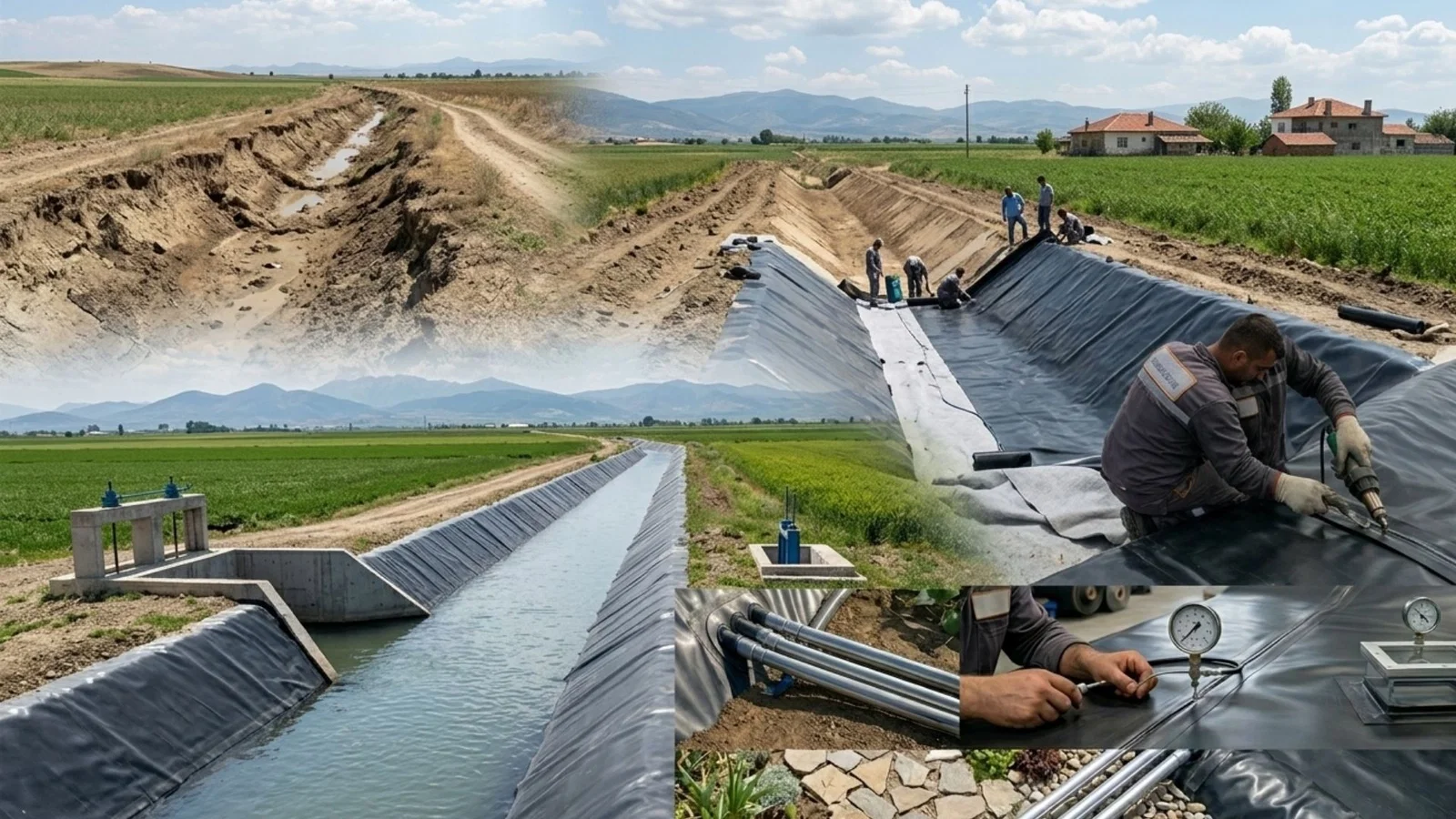
Engineering Foundations of Canal Coating Technology with Geomembrane Using geomembrane in the rehabilitation of irrigation canals is a method called “canal lining” in engineering literature that brings water transmission efficiency close to 100 percent. In this method, after correcting the cross-section of the existing earth canal, polymeric sheets laid on the ground completely cut off contact between water and soil.
HDPE and LLDPE geomembranes, thanks to their high hydraulic smoothness coefficients, reduce friction resistance and increase flow speed. This allows more discharge to be passed through a channel with the same cross-sectional area.
MZ Ticaret’s high-performance geomembrane solutions fully adapt to the channel’s geometric shape, allowing water to flow smoothly without turbulence. The material’s flexible structure prevents microcracks caused by ground movements or freeze–thaw cycles, extending the system’s watertight life far beyond that of concrete linings.
Modern canal rehabilitation is the process of controlling nature’s irregularity with engineering discipline. Superiority of Geomembrane Systems over Concrete-Coated Channels The concrete lining method, widely used in irrigation canals for years, has begun to show serious disadvantages over time.
Because concrete is a rigid material, it is sensitive to ground settlement and temperature changes; cracks that form become leakage paths, reducing system efficiency. In contrast, geomembrane-based rehabilitation systems, with options such as “composite lining” or “single geomembrane lining,” are much more durable and economical than concrete.
At MZ Ticaret, we successfully apply geomembrane lining as a rehabilitation method for old and cracked concrete canals. Unlike concrete, geomembrane is not affected by chemicals in the water or sulfate soils and does not corrode.
In terms of application speed, covering kilometer-long canals with geomembrane is completed in a much shorter time than concrete pouring, allowing it to be ready for the irrigation season. Compared with investment cost and service life, the flexibility and total watertightness provided by polymeric barriers offer a far more sustainable model than the rigidity of concrete.
Ground Preparation and Geometric Correction Processes in Canal Rehabilitation To successfully coat a canal with geomembrane, the canal bed must first be physically prepared. Vegetation, large rock fragments, and sharp objects in existing earth canals are removed, and the canal cross-section is reshaped to fit the project.
The slope of the canal banks must be determined by engineering calculations to keep the geomembrane stable and prevent soil slips. MZ Ticaret’s field teams lay geotextile blankets that act as cushioning over the prepared ground, protecting the geomembrane from underground cutting elements.
Precise compaction during ground preparation directly affects the canal’s hydraulic performance. Gaps left on the canal base or side surfaces can cause excessive tension on the geomembrane when water loads it, so surface smoothness is vital.
Proper ground preparation is the fundamental step that keeps the insulation layer mechanically stable for decades. Heat Welding Techniques and Continuous Sealing Along the Canal The weakest link in the watertightness of kilometer-long irrigation canals is the additional joints where roll-shaped materials are connected.
MZ Ticaret uses the latest automatic fusion welding machines in canal projects to achieve molecular-level bonding. The double‑stitch welding method leaves an air channel between two weld lines, allowing each meter to be tested for watertightness.
These continuous welds along the canal turn the system into a single, seamless piece. At points where the canal meets reinforced concrete structures such as control rooms or bridge crossings, mechanical fastening profiles and chemical sealing tapes are used.
Heat‑welding technology preserves the geomembrane’s flexibility while providing higher strength at the joints than the main material. This technological discipline guarantees that water reaches its destination without leakage anywhere along the transmission line.
Bank Stability and Rough‑Surface Geomembranes in Sloped Channels In steep‑banked channels, there is a risk that protective soil or concrete layers laid over the geomembrane may slide downward. To manage this risk, MZ Ticaret recommends using geomembranes with specially textured surfaces.
A rough surface increases the friction coefficient between the geomembrane and the layer above or the ground below, ensuring system stability. This feature is critical for safety and system life, especially in wide and deep main transmission channels.
With rough geomembranes, steeper bank angles can be used, reducing excavation volume and saving overall project costs. Correct calculation of the friction angle allows the canal to maintain structural integrity even under dynamic loads such as earthquakes or sudden water level changes.
The stability provided on sloped surfaces creates the engineering infrastructure needed for safe high‑speed water flow. UV Resistance and Protection Against Atmospheric Conditions Irrigation canals are exposed directly to sunlight and outdoor conditions, so the UV resistance of the geomembrane is the most critical factor determining the project’s lifespan.
The HDPE geomembranes supplied by MZ Ticaret provide full protection against the destructive effects of the sun thanks to their high carbon black content and stabilizers. Thermal expansion in hot summer months and contraction in winter cause cracks in low‑quality plastics, while high‑quality geomembranes absorb these thermal stresses with their elastic structures.
When the water level in the canal drops, the exposed edge sections must not become brittle under the sun; this is essential for continuous watertightness. With service lives exceeding thirty years, these materials ensure that a single investment serves generations.
Resistance to atmospheric conditions protects not only the surface but the entire molecular structure of the material, guaranteeing system reliability. Anchor Trenches and Wind Vacuum Management in Canal Rehabilitation The wind vacuum effect in open canals can cause geomembrane sheets to lift or ripple.
To counter this physical effect, anchor trenches are created on the upper parts of both sides of the canal. The geomembrane edges are buried into these trenches and filled with soil or concrete.
In MZ Ticaret’s application standards, the depth and fill type of anchor trenches are determined based on the region’s wind map and canal width. A properly anchored system also resists the buoyant force of water.
During cleaning periods when water is drained from the canal, the geomembrane’s adhesion to the ground and its shape depend on these fastening details. Anchor systems are a critical detail that transforms a superficial insulation layer into a structural engineering system, locking the system against external factors.
Sediment Management and Canal Cleaning with Geomembrane Sediment carried by water in earth canals sticks to irregular surfaces, narrowing and clogging the canal cross‑section. This requires costly annual cleaning operations.
In channels lined with a smooth‑surface geomembrane, sediment attachment is much harder; the water flow exhibits a self‑cleaning property. Completely preventing clogging preserves flow speed while reducing maintenance costs by up to sixty percent.
In canals rehabilitated by MZ Ticaret, periodic cleaning can be performed quickly with light equipment or high‑pressure water without damaging the geomembrane. A clean, smooth canal line reduces transmission losses and helps maintain oxygen levels in the water, improving water quality.
Maintenance ease is a hidden economic advantage that increases the project’s profitability during operation. Transition from Wild Irrigation to Modern Irrigation: Canal Efficiency The key to transitioning from traditional methods to modern drip and sprinkler irrigation systems worldwide is preventing losses in water transmission lines.
If half of the water released from a dam disappears en route, even the most modern irrigation technology cannot achieve the expected savings. Main and auxiliary canals rehabilitated with geomembrane preserve the source pressure and flow to the field entrance.
At MZ Ticaret, the solutions we offer for state‑supported irrigation projects enable fair and efficient water distribution. This increase in transmission efficiency allows much larger areas to be irrigated with the same water source, thereby increasing agricultural yield.
Canal rehabilitation is the starting point of agricultural development and ensures that every drop of water is managed in a controlled manner. Modern irrigation is a system that rises on watertight transmission lines.
Cost Analysis and Payback Period in Canal Rehabilitation In a project to line an irrigation canal with geomembrane, cost analyses should be based on the value of the water gained and the reduction in maintenance costs. When the cost of water loss in earth canals, electricity used for pumping, and lost crop yield are summed, the geomembrane investment typically pays itself back in two to four years.
MZ Ticaret prepares the most economical and long‑lived cross‑section designs with cost‑benefit analyses for investors and cooperatives. Considering the frequent crack repair and joint renewal costs of concrete canals, the life‑cycle cost (LCC) of geomembrane systems is much lower.
In a world where the unit price of water is rising each year, stopping transmission losses is not only an environmental responsibility but also a necessary financial decision. These efficiency‑focused investments increase businesses’ resilience to risks such as drought.
International Quality Standards and GRI‑GM13 Certification The quality of the geomembrane used in irrigation canal projects is the most important factor determining the project’s success. The HDPE geomembranes supplied by MZ Ticaret meet the most stringent internationally accepted standards such as GM13 set by the Geosynthetic Institute (GRI).
These standards guarantee all technical parameters from tensile strength to tear resistance, carbon black distribution, and oxidation induction time. “Below‑the‑floor” productions that do not meet quality standards can disintegrate under the sun within one or two years, causing project failure.
Matching the values in technical data sheets (TDS) with field performance is the foundation of trust in engineering projects. The products we offer provide long‑term assurance for your projects with performance proven by accelerated aging tests in laboratory conditions.
Quality is not a luxury; it is the fundamental requirement of watertight projects. Positive Environmental Impact on Local Communities and Ecosystems Canal rehabilitation not only increases agricultural productivity but also protects the surrounding ecosystem.
Uncontrolled seepage from earth canals can damage foundations of nearby settlements, cause road subsidence, or turn agricultural lands into swamps. Geomembrane‑sealed canals keep water confined to the planned corridor, preventing such secondary damages.
MZ Ticaret’s watertight solutions prevent underground water salinization, helping preserve soil health. Moreover, by using water more efficiently, the amount of water drawn from rivers and reservoirs can be reduced, contributing to the protection of natural water cycles and aquatic life.
Geomembranes made from environmentally friendly materials support a sustainable future with their recyclable end‑of‑life properties. Emergency Response and Rapid Repair Options for Continuous Irrigation Physical damage that can occur in a canal during the irrigation season can mean disaster for agricultural production.
While repairing major fractures in concrete canals can take days, perforations or tears in geomembrane‑lined canals can be fixed within hours. After the damaged area is dried and cleaned, a geomembrane patch applied on top is sealed with an extruder in seconds, restoring watertightness.
MZ Ticaret provides technical support and rapid‑repair kits for such emergencies during operation, ensuring uninterrupted irrigation. The repairability of the material is an operational advantage that increases system flexibility and reliability.
Continuous water flow means the farmer’s labor and product safety. Future Smart Canal Systems and Digital Integration In the future, irrigation canals will become smart networks capable of detecting leakage points in real time through sensors and flow meters installed on them.
Geomembrane‑based watertight systems provide the optimal platform for integrating such digital monitoring technologies. At MZ Ticaret, we closely follow global developments in watertight technology and continue to offer the most modern and efficient solutions for your projects.
Water management is now not just a physical transmission but a data‑driven optimization process. Building climate‑resilient agricultural structures is possible by laying foundations today with the right, high‑quality materials.
Canals rehabilitated with geomembrane will be the guardians of the water that is our greatest wealth in a water‑scarce world tomorrow. Every canal designed with technological discipline and material expertise is a safe bridge to fertile soils.