
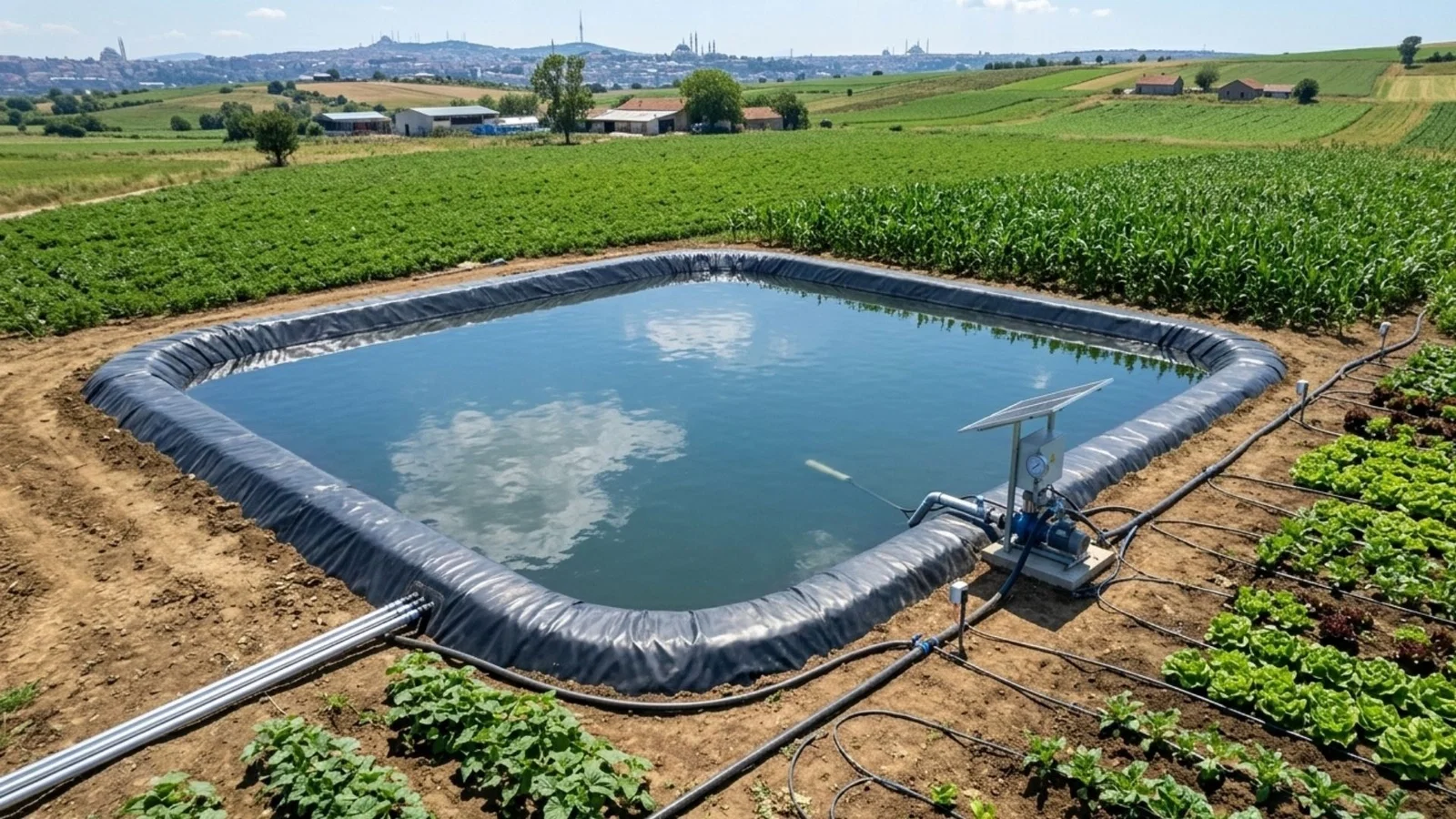
Methods for Preventing Water Loss with Geomembrane
Global Water Crisis and the Strategic Role of Geomembrane Barriers in Pond Isolation The rapid depletion of freshwater resources worldwide and the increasing risk of droughts associated with climate change have made the storage and protection of water one of modern engineering’s most critical priorities. Agricultural irrigation ponds, fire-fighting reservoirs, and decorative artificial lakes face serious water losses from the moment they are built due to soil permeability.
Traditional soil beds or standard reinforced concrete structures lose their impermeability over time under the hydrostatic pressure of water, allowing valuable water to seep underground. At this point, geomembrane technology emerges as the most effective solution that brings water loss and leakage rates to zero and protects every drop of water.
At MZ Ticaret, the high‑performance geomembrane systems we offer create an impenetrable barrier between water and soil, preserving water while preventing the artificial disturbance of the underground water level. Sustainability in water management is possible not only by collecting water but also by protecting the collected water in a leak‑proof environment with minimal loss.
Ground Permeability and Water Loss Mechanisms Under Hydrostatic Pressure When a pond is constructed, the pressure from the water’s own weight tends to seep through the pores and cracks in the ground. In areas with sandy or gravelly soil, the entire volume of water in an uninsulated pond can seep underground within a few weeks.
This can lead not only to water loss but also to softening of the surrounding soil and the formation of landslide risks. Geomembrane barriers stop this physical seepage process at the molecular level.
Thanks to their polymeric structure, these sheets do not allow water molecules to pass, withstand hydrostatic pressure, and distribute the load evenly onto the sub‑soil. MZ Ticaret’s technical analyses emphasize that projects started without a soil study have a high risk of long‑term failure.
The correct geomembrane selection isolates the pond, turning it into a closed‑loop system. This engineering approach is a vital insurance policy for maintaining agricultural productivity in dry regions.
Economic Efficiency of Geomembrane Use in Agricultural Irrigation Ponds Water is one of the largest cost components for farmers and agricultural enterprises. The loss of water collected from irrigation channels or artesian wells due to leaks in storage areas represents a significant economic damage.
A geomembrane‑insulated irrigation pond stops all losses except evaporation. The installation cost is much lower than reinforced concrete pools, and the shorter application time accelerates the return on agricultural investments.
MZ Ticaret’s HDPE and LLDPE geomembrane solutions offer high resistance to fertilized waters and agricultural chemicals, protecting not only water but also the valuable nutrients mixed into it. In long‑term projections, the water savings provided by a geomembrane‑lined pond amortize the material’s cost within a few irrigation seasons.
Efficient farming starts with smart water management, and the cornerstone of that management is a flawless isolation layer. Aesthetic and Functional Isolation in Decorative Ponds and Artificial Lakes Artificial lakes used in landscape architecture and urban recreation must provide an aesthetic appearance while preventing water seepage and maintaining structural safety.
In decorative projects, flexible PVC or LLDPE geomembranes are often chosen due to the complex shapes and curves of the ground. These materials wrap the ground like a skin, matching the natural look of the pond.
MZ Ticaret offers system designs that allow gravel, stone, or vegetation layers to be safely applied over the geomembrane, preventing visual pollution. High‑UV‑resistant products do not crack or become brittle even when exposed to sunlight when the water level drops.
In artificial lake projects, leaks can cause not only water loss but also serious legal and technical problems such as water seeping into the foundations of nearby buildings. A professional geomembrane installation eliminates all these risks, allowing the project to be enjoyed for many years.
Pond Ground Preparation: Excavation, Compaction, and Protective Layer Application The most critical phase of successful pond isolation is the ground preparation before laying the geomembrane. After excavation, all sharp stones, tree roots, and sharp objects must be completely removed from the pond area.
The cleaned ground must be compacted with rollers to create a smooth surface that will not puncture the material when it is laid. MZ Ticaret’s application protocols recommend laying a high‑grade geotextile protective fleece between the soil and the geomembrane.
This fleece layer cushions the geomembrane, increases its mechanical resistance, and prevents potential micro‑movements in the ground from damaging the material. Neglecting ground preparation can introduce leakage risk even if the world’s best geomembrane is used.
Properly excavated anchorage trenches and the correct burial of the geomembrane edges into these trenches stabilize the system against wind vacuum and buoyancy forces. Welding Technology and Leak‑Proof Assurance at Joints In pond isolation, geomembrane sheets are joined in the field using thermal welding methods.
Automatic double‑stitch fusion welding machines are used for large areas, while hand extruders are employed for pipe outlets and corner details. Welding quality is the most sensitive factor determining the pond’s lifespan.
Each weld seam must fuse the two materials into a single body. After welding, MZ Ticaret’s technical teams subject all seams to air‑pressure tests to mathematically confirm leak‑proofness.
Air pressed into the channel between double‑stitch welds must remain pressure‑stable for a specified time. This test is the final safety check before filling the pond.
The speed of field application and the consistency of weld quality directly affect the time the pond can be put into operation. A flawless joining technology is a magical touch that turns thousands of square meters into a leak‑free water reservoir.
UV Resistance and Long‑Term Protection Against Atmospheric Conditions Ponds exposed to the open air are subjected to harmful ultraviolet rays, extreme heat, and freezing risks all year round. Low‑quality polymers lose their molecular structure quickly under the sun, harden, and crack.
The HDPE and LLDPE products supplied by MZ Ticaret, thanks to their carbon black and special stabilizers, offer service lives exceeding thirty years. Even in snow and ice conditions, these materials retain elasticity, easily handling the stresses caused by water expansion when freezing.
When the pond’s water level changes seasonally, the durability of the sides directly exposed to sunlight becomes critical. High UV resistance prevents color fading and physical degradation, preserving the system’s integrity.
A durable insulating barrier acts as a structural shield against nature’s harshest conditions, protecting the investment’s value. Water Loss‑Leak Analysis: Evaporation or Leakage?
One of the most common concerns of pond operators is whether a drop in water level is due to normal evaporation or a hidden leak. Evaporation is a natural process dependent on humidity, wind, and temperature, while leakage is a technical fault that must be controlled.
In a fully insulated pond, water loss occurs only through evaporation. If the water level drops faster than expected, a problem may exist in the weld seams or mechanical damage.
MZ Ticaret offers advanced diagnostic services such as electrical methods or vacuum tests to quickly identify the source of the leak. The geomembrane, the most radical and definitive solution for preventing water loss, eliminates such uncertainties.
In a leak‑verified pond, every centimeter of water becomes a predictable resource for the owner, forming the basis of financial planning in industrial processes where water cost is high. Biological Resistance Strategies Against Plant Roots and Rodents Ponds, being integrated with nature, can be threatened by surrounding plant roots or underground rodents that attack the isolation layer.
Many traditional insulation materials can be penetrated by plant roots, whereas the smooth, hard surface of HDPE geomembranes prevents root attachment and penetration. Biological resistance is one of the most important reasons for choosing geomembrane technology in pond isolation.
MZ Ticaret’s solutions provide complete immunity against underground microorganisms. These systems do not rot or emit odors in damp underground environments, protecting water without harming ecological balance.
Protective layers and anchorage trenches used in ground preparation add extra security against rodent damage. A barrier that harmonizes with natural life yet resists biological threats is the key to long‑term leak‑proof success.
Geomembrane Advantages in Pond Repair and Maintenance Physical damage caused by accidents during construction or operation can be repaired quickly and easily in geomembrane systems. After a punctured or torn area is dried and cleaned, a patch of the same material is mounted using an extrusion weld or a hot‑air hand weld.
This repair does not require the days‑long grouting and re‑pouring processes typical of reinforced concrete. MZ Ticaret also provides technical support during maintenance of existing ponds, extending the system’s leak‑proof life.
Periodic visual inspections and weld seam reviews prevent major problems before they arise. Low maintenance costs make geomembrane isolation the most economical solution in terms of total life‑cycle cost.
Rapid intervention allows local repairs without draining pond water, offering a significant advantage in water savings. Hygienic Isolation Standards for Drinking Water and Fish Farming Some ponds are used not only for irrigation but also for drinking water storage or fish farming (aquaculture).
In such projects, it is vital that the geomembrane does not release any toxic substances into the water. Food‑grade HDPE geomembranes do not alter water quality and provide a safe environment for living organisms.
At MZ Ticaret, we require the use of internationally NSF‑certified products in drinking water projects. Using geomembranes in fish ponds helps maintain oxygen levels and reduces the risk of disease from contact with the ground.
The smooth surface also makes cleaning the pond easier. Hygienic isolation protects both human health and the well‑being of aquatic life.
Maintaining water quality is as important a performance criterion as leak‑proofness, and this is only possible with the correct polymer selection. Future Pond Technologies in Sustainable Water Management In future cities and agricultural areas, smart ponds equipped with floating solar panels will reduce evaporation and generate energy.
The core of these integrated systems is again a reliable geomembrane isolation layer. MZ Ticaret follows technological evolution by integrating sensor‑based leak detection systems into geomembrane projects.
These sensors can instantly report even the smallest deformation in the isolation to the central system. Data‑driven water management, knowing exactly where every drop of water is, will eliminate waste entirely.
Pond isolation is no longer just digging soil and laying a membrane; it becomes part of a digital ecosystem. Ponds built with innovative approaches and high‑quality materials will be one of the most valuable legacies we leave for future generations, safeguarding water.