
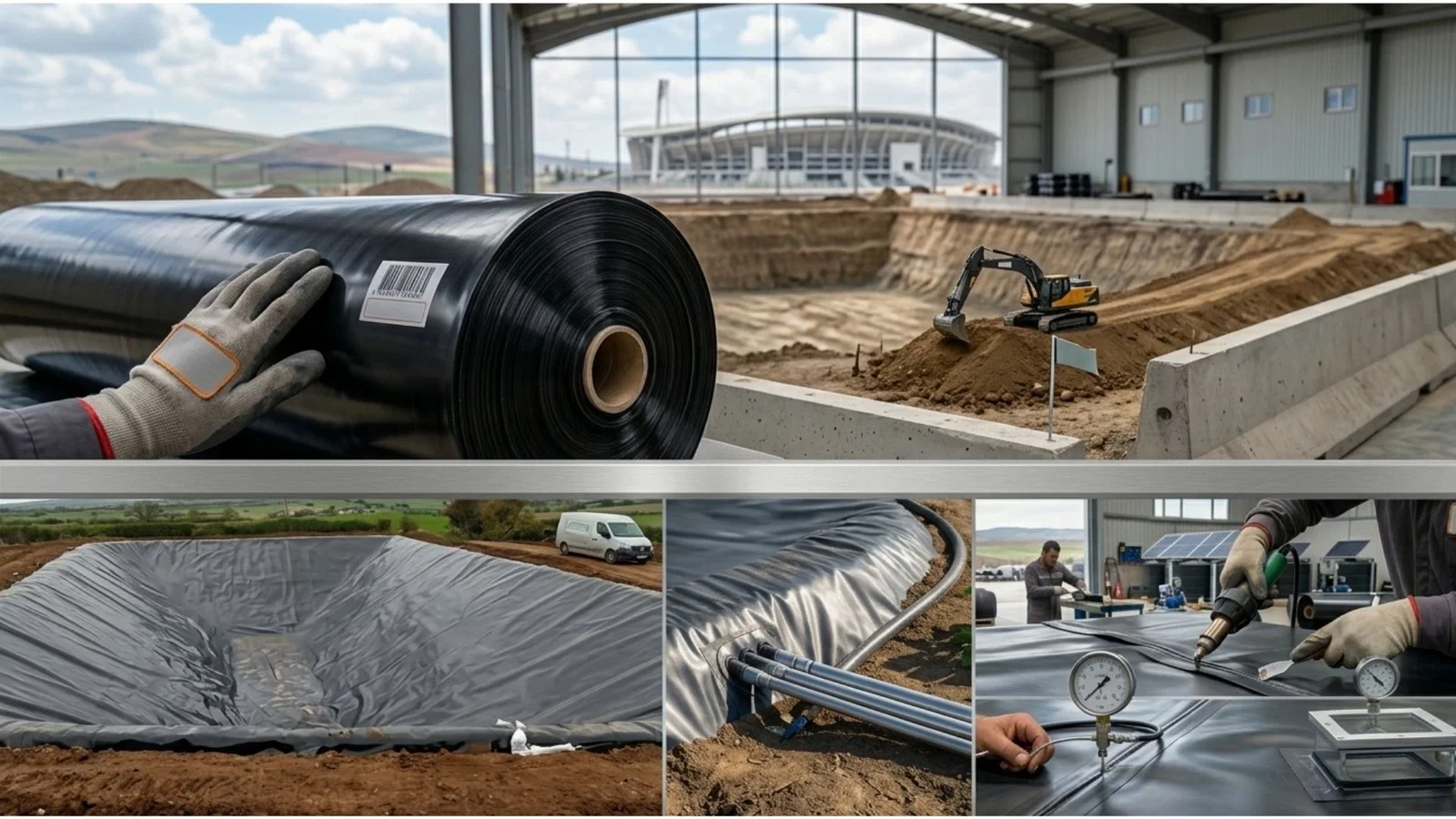
HDPE Geomembrane Prices and Application Cost Analysis
HDPE Geomembrane Prices: Key Factors Determining Prices and the Global Raw Material Index One of the first and most important questions that arise when budgeting industrial leak‑proofing projects is the variability in HDPE geomembrane prices. The unit cost of high‑density polyethylene sheets depends not only on local market conditions but also directly on global oil prices and the instantaneous fluctuations in the polymer resin market.
Because polyethylene is a crude‑oil derivative, every increase in energy costs is reflected in geomembrane production costs. However, focusing only on the roll price when analyzing a project’s total cost can mislead investors.
Choosing a high‑quality HDPE geomembrane is a strategic investment that reduces long‑term maintenance and repair expenses, thereby lowering the project’s total cost of ownership. At MZ Trade, we follow world standards in raw‑material selection and adopt a policy that protects investors in the price‑performance balance.
Resin purity, the material’s UV resistance, and chemical resistance are hidden quality indicators behind the label price. Geomembranes made from cheap but non‑standard raw materials can cause field failures such as lack of welding or premature aging, turning initial savings into significant financial losses.
Therefore, when conducting unit‑price analysis, it is crucial to compare the technical data sheet (TDS) values with international GRI‑GM13 standards. Material Thickness and Roll Size Directly Affect Project Budgets When calculating HDPE geomembrane prices, the most decisive physical parameter is material thickness.
In the industry, thicknesses typically range from one to three millimeters; as thickness increases, the amount of polymer per square meter and consequently the price rise proportionally. In a solid waste storage site, a two‑millimeter thickness is considered standard for leak‑proofing, whereas a one‑millimeter product may suffice for a simple decorative pond project.
Selecting material thicker than needed creates an unnecessary cost burden, while choosing an unsuitable thin material increases puncture and leakage risks, jeopardizing the entire investment. MZ Trade’s technical consultants help you choose the most rational thickness by analyzing the static load the project will bear and the aggressiveness of the ground.
Roll widths are also a hidden factor affecting application costs. Wider rolls reduce the number of weld seams required on site, lowering labor costs and reducing leakage risk.
Optimizing roll weights to match transport vehicle capacities can provide a five to ten percent advantage in the overall budget. Analysis of Application Labor and Technical Installation Costs In a leak‑proofing project, only fifty to sixty percent of the cost comes from material; the remainder consists of application and site‑management expenses.
HDPE geomembrane installation is a discipline that requires high technical expertise and certified equipment. Depreciation of welding machines, operator skill levels, and daily throughput capacities are the main factors determining application prices.
In particular, on sloped surfaces, in complex details with many pipe outlets, or when working under adverse weather conditions, labor unit prices vary. MZ Trade’s field teams use state‑of‑the‑art double‑stitch fusion‑welding robots to achieve the highest throughput per unit time with zero defects.
Fast and flawless application reduces site costs and ensures the project is delivered on schedule. The most effective way to lower application costs is to hand the project over to a professional team, thereby avoiding the return costs caused by faulty welds or incorrect alignment.
Labor quality is the most critical factor determining the material’s lifespan; any compromise in this area can lead to long‑term irreparable damage. Ground Preparation and Protective Layers’ Share in Total Investment While researching HDPE geomembrane prices, another often overlooked but significant component in the overall budget is ground preparation and auxiliary products.
Geomembranes must protect themselves from cutting objects in the underlying ground. If the ground is heavily stone‑laden or rough, a geotextile mat of a certain weight must be laid beneath the geomembrane.
This mat layer provides mechanical protection, eliminating point puncture risks. Although increasing geotextile weight raises unit cost, it is an option, not a choice, for geomembrane safety.
Ground compaction, drainage channel excavation, and anchor pit digging are also included in the application cost analysis. At MZ Trade, when designing a holistic leak‑proofing system, we ensure that not only the geomembrane but also complementary products such as geocomposite drainage layers and bentonite clay covers (GCL) are incorporated cost‑effectively.
Proper ground preparation distributes the loads that will sit on the geomembrane evenly, reducing the material’s physical fatigue and increasing overall system reliability. Optimizing Logistics, Storage, and Site Management Costs In large‑scale projects, transportation and on‑site logistics are the invisible heroes of HDPE geomembrane cost analysis.
Moving rolls from the manufacturing facility to the application site, especially over long distances, can significantly affect the unit price per square meter. MZ Trade’s logistics network is designed to minimize delivery times and costs.
Improper stacking on site, leaving materials exposed to the sun for extended periods, or having heavy machinery pass over rolls can cause damage, driving up total cost. Professional site management aims to prevent losses at every stage from material arrival to final testing.
Stock management and pre‑planned lay‑down schedules using engineering software can reduce waste rates to below two percent, yielding substantial savings. In foreign‑currency‑priced materials, each percentage point reduction in waste directly translates to profitability.
Synchronizing transport planning with project progress eliminates unnecessary waiting times and additional crane costs. Financial Burden of Quality Control Tests and Certification Processes Air‑pressure tests, vacuum trials, and destructive laboratory tests performed at the delivery stage of a leak‑proofing project may appear as additional costs at first glance, but they are reports that prove the investment’s safety.
Although their cost occupies a small portion of the total budget, the assurance they provide is priceless. Firms that report in accordance with international audit standards can bring the project under insurance coverage and accelerate approval processes from official bodies.
At MZ Trade, we record every square meter of welding and include all required field tests in our unit prices, offering a transparent service. Unrecorded and unregulated applications can cost three to four times the original application fee once a leak is detected and the site must be reopened and repaired.
Therefore, when requesting a quotation, always verify whether testing and reporting services are included. The quality‑control process is an indispensable part of engineering and the foundation of long‑term operational safety.
HDPE Advantage from a Long‑Term Maintenance and Operating Cost Perspective When evaluating HDPE geomembrane prices, one of the most important factors for investors is the material’s service life. Considering that a reinforced concrete pool requires crack repair and surface renewal every ten to fifteen years, the economic superiority of HDPE systems that require no maintenance for twenty‑to‑thirty years becomes evident.
High‑density polyethylene’s resistance to biological degradation, plant roots, and rodents eliminates surprise expenses during the operating period. UV‑resistant products supplied by MZ Trade retain their molecular structure even under direct sunlight, saving on additional protective layer costs.
Reducing water loss and leakage to zero, especially in irrigation projects where water costs are rising daily, allows the investment to pay for itself within a few years. In financial analyses based on “life‑cycle cost,” HDPE geomembranes are the most economical and sustainable insulation technology worldwide.
Sector‑Based Price Variations: Mining, Waste, and Pond Projects HDPE geomembrane prices vary according to the risk profile of the sector in which they are applied. In mining sites, especially in cyanide leach ponds, stricter specifications and special chemical‑resistance certifications are required, driving up material costs.
In solid waste storage sites, dual‑layer systems and intermediate drainage layers for leakage water management affect the total project cost. In contrast, agricultural irrigation ponds can use more standard products and fast‑installation techniques, keeping unit costs competitive.
MZ Trade performs “tailor‑made” cost‑estimations by analyzing each sector’s unique economic and technical needs. Instead of relying on a single price list, we examine every detail—from site topography to climate conditions—to prepare the most optimized quotation.
This approach prevents unnecessary spending and ensures the budget is used most efficiently. Sector expertise not only prices the material correctly but also the project’s overall risk management.
Impact of Foreign Exchange Rates and International Trade Policies on the Turkish Market The Turkish geomembrane market is heavily dependent on raw materials, so currency fluctuations directly affect price lists. U.S.
dollar or euro‑based raw‑material indices are the biggest source of uncertainty in local project budgeting. At MZ Trade, we mitigate these fluctuations for our customers through strategic stock management and long‑term raw‑material contracts.
Customs duties, additional financial obligations, and changes in international freight rates also shape the cost structure of imported or exported products. While increased domestic production capacity may stabilize prices, raw‑material quality remains synchronized with global markets.
Investors should manage quotation validity periods and payment schedules carefully, considering this variability in their budget approval processes. Financial instruments such as forward purchases or early‑payment discounts can be used strategically to manage total cost.
Recycling and Scrap Value at the End of the Economic Life Another hidden economic advantage of HDPE geomembrane systems is their recycling potential at the end of their service life. High‑density polyethylene is a recyclable thermoplastic.
When a facility reaches the end of its life or material must be removed from the site, cleaned HDPE pieces retain value as raw material for the plastic industry. Unlike costly-to‑dispose materials such as bituminous membranes or concrete waste, HDPE geomembranes have a specific scrap value.
This feature allows a portion of the costs to be financed during the demolition phase of large‑scale projects. MZ Trade supports environmental sustainability by ensuring that its products do not become an environmental burden at the end of their life cycle and are re‑introduced into the economy.
The recyclable nature of HDPE adds prestige and points in green‑building certifications (LEED, etc.) and environmental impact assessments. Minimizing the “Wrong Decision” Cost in Project Budgets The biggest mistake in leak‑proofing projects is going for the lowest‑priced offer.
A user searching for “geomembrane prices” should examine in depth the reasons behind a ten‑percent difference between offers. This difference usually stems from raw‑material purity, UV protection level, the professionalism of the application team, or the scope of testing services.
Repairing a leaking pond due to wrong material selection or faulty application often requires a demolition and reconstruction process that exceeds the original project cost. At MZ Trade, our mission is not to offer the cheapest bid but the “lowest‑risk and highest‑efficiency” proposal.
In engineering, the cost of cheapness is always higher. A transparent cost analysis that combines material quality with application expertise yields the most accurate result.
Consistency in leak‑proofing is the outcome of an investment that delivers confidence for decades. Economic and Technical Assurance for a Sustainable Future HDPE geomembrane technology offers economic solutions to modern world’s most critical environmental problems, from protecting water resources to containing hazardous waste.
Cost analyses show that a properly designed geomembrane system is both nature‑protecting and budget‑friendly. At MZ Trade, we are with you in your leak‑proofing projects, providing the latest raw‑material data and field experience.
By offering technically and financially optimized solutions at every stage of your investment, we help you build a safe future. When economic efficiency, engineering discipline, and environmental responsibility converge, geomembrane projects become a shared benefit for industry and nature.
Technical excellence and cost‑effective approaches are the two indispensable pillars of the leak‑proofing world.