HDPE Geomembrane Applications for Waste Site and Pond Insulation
The Strategic Role of High‑Density Polyethylene Geomembranes in Engineering Infrastructure In modern construction and environmental engineering projects, creating a waterproofing layer is not only an insulation process but also a responsibility to protect underground resources. High‑density polyethylene (HDPE) geomembranes—referred to as HDPE geomembranes—are advanced technology products that, due to their molecular structure, form an impenetrable barrier against liquid passage.
These materials, among the highest points reached by polymer technology, possess one of the lowest permeability coefficients in the world because of the crystalline structure in their raw material. This unique feature has made the use of HDPE geomembranes a global standard, especially in sites where hazardous waste is stored and in massive irrigation ponds.
Choosing the right insulation material during the planning phase of a project is the most critical engineering decision that directly determines the structure’s economic life and environmental safety. HDPE continues to be the first choice for professionals because of its extraordinary tensile strength and tear resistance compared with other conventional clay or concrete methods.
The high‑standard geomembrane solutions offered by MZ Ticaret are specially formulated to adapt to the toughest ground conditions and mechanical stresses on site. Their durability is not limited to physical impacts; it also provides full protection against microbiological attacks that may occur underground, meaning the material can perform its function for decades without losing its shape.
High‑quality resins used in the manufacturing process ensure a homogeneous structure, guaranteeing the same waterproofing performance at every point on the surface. Chemical Resistance and Leak‑Water Management Principles in Waste Storage Sites Sites where industrial, domestic, or mining waste is stored create a ground for the formation of percolate—aggressively chemical leak water—over time.
The infiltration of heavy‑metal and toxic‑substance‑laden liquids into the soil poses a risk large enough to cause irreversible environmental disasters. The undisputed superiority of HDPE geomembranes in this area stems from their enormous chemical resistance capacity.
Even when in direct, continuous contact with the harshest acids, bases, or hydrocarbon‑containing chemicals, the molecular structure of HDPE shows no signs of dissolution or weakening. This stability allows the geomembrane layer used for the base insulation of the waste site to continue its waterproofing function even during passive monitoring periods after the facility’s active operating life has ended.
When leak‑management strategies are developed, the geomembrane layer is usually designed as a whole with geocomposite drainage layers and protective geotextiles. These multi‑layer engineering structures allow the leak to be contained at its source and discharged in a controlled manner even in the event of unexpected physical damage from outside.
Because safety is as important as operational efficiency in waste management, high‑density polyethylene geomembranes that require no maintenance in the long term and offer a high safety margin form the cornerstone of rational investment. Even after the facility is closed, the natural structure of the soil remains intact, directly depending on the success of the geomembrane barrier.
Zero Water Loss in Pond Applications and Increased Agricultural Productivity The biggest engineering problem encountered in agricultural irrigation ponds, fire‑water reservoirs, or landscape‑focused artificial ponds is the massive loss of water due to natural absorption by the ground. In regions where water resources are limited and the risk of drought is increasing, preserving every cubic meter of water is a strategic necessity.
In a flawlessly completed pond project using HDPE geomembranes, water loss other than evaporation can theoretically be reduced to zero. Compared with reinforced concrete pond structures, geomembrane applications are far more economical in cost and provide an incredible speed advantage in installation time.
Concrete, being rigid and brittle, tends to crack even with the slightest soil settlement, whereas HDPE geomembranes can stretch with ground movements thanks to their high elasticity. This flexibility distributes the tremendous water pressure that occurs when the pond is at full capacity evenly across the ground, preventing local structural damage.
HDPE products used in ponds are often exposed directly to atmospheric conditions and solar radiation, so the production formula includes a high percentage of carbon black and special UV stabilizers. These protective additives prevent the sun’s destructive rays from damaging the polymer chains, avoiding brittleness or cracking on the geomembrane surface.
UV‑resistant geomembranes supplied by MZ Ticaret guarantee the future of water even in the harshest climates, with service lives exceeding twenty years. Geomembrane Production Technologies and the Impact of Raw‑Material Quality on the Final Product The quality of a geomembrane begins with the selection of raw material and the extrusion process in the factory.
The high‑density polyethylene resin determines the material’s density, melt flow index, and resistance to environmental stress cracking. Polymers formed into sheets on the production line are frozen through cooling cylinders to achieve the desired thickness precision.
Antioxidants added to the material protect against long‑term thermal oxidation, while carbon black increases opacity and solar resistance. In a quality production process, the material’s surface must be free of microscopic voids or roughness.
Smooth‑surface geomembranes are preferred in water‑conveyance channels because they reduce friction, whereas textured surfaces are produced to prevent slipping in steep areas. MZ Ticaret supplies geomembranes with the most suitable surface structure for each project’s geographic and technical conditions, enhancing application safety.
Even the smallest deviation in raw‑material quality can lead to field failures such as lack of adhesion or premature aging, so every production batch must undergo mechanical and chemical tests in a laboratory. Full compliance with technical specifications ensures smooth passage through project inspection processes and allows the end user to use the system safely for many years.
Ground Preparation Processes and Technical Requirements for Protective Layers The success of a geomembrane application on site depends not only on the material’s quality but also on the engineering suitability of the auxiliary layers placed beneath and above the membrane. During the ground‑preparation phase of the site where the application will occur, it is essential to remove all cutting stones, plant roots, construction waste, and sharp objects from the surface.
The smoother and better compacted the ground, the lower the point stresses on the geomembrane and the minimized risk of puncture. In most professional projects, a non‑woven geotextile layer is laid beneath the geomembrane as a primary protective barrier.
This textile layer acts as a mechanical cushion, preventing unpredictable ground roughness from damaging the membrane. In some specific projects, bentonite‑clay covers (GCL) are combined with the geomembrane to create a composite waterproofing system.
This dual‑barrier structure works on the principle that even if a hole forms in the geomembrane due to an external impact, the bentonite swells upon contact with water and automatically plugs the hole, making the system self‑repairing. For the upper layer protection, if cleaning equipment will operate inside the pond or pedestrian/vehicle traffic is anticipated, another protective geotextile and then a certain thickness of backfill or protective concrete are applied over the geomembrane.
Integrating all these layers into a single engineering integrity on site is considered an indispensable application standard in MZ Ticaret projects. Controlling the moisture content of the ground and correctly arranging drainage layers also prevents gas build‑up and swelling under the geomembrane.
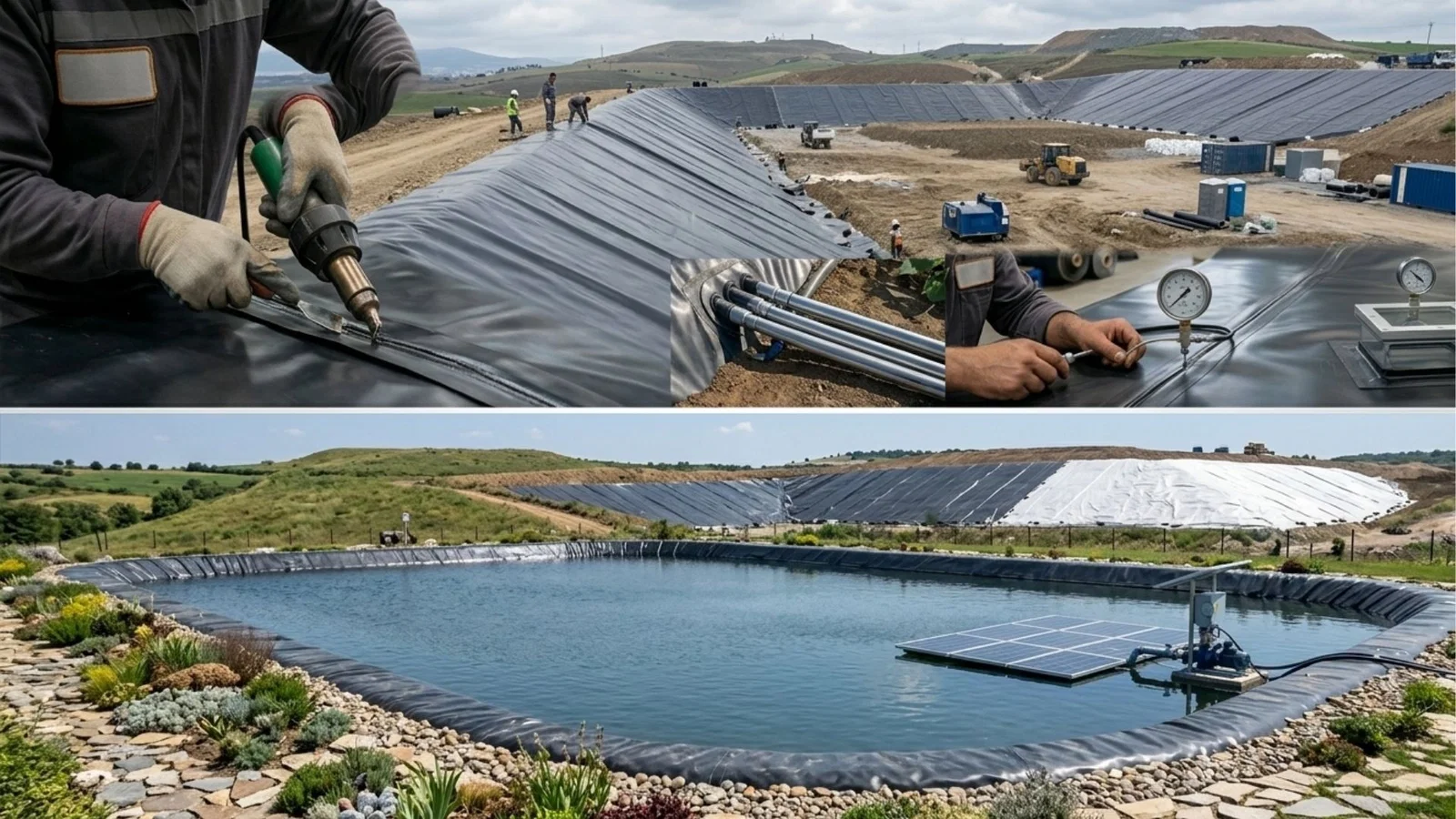
Advanced Thermal‑Welding Technologies and Field‑Quality Control Tests The process of joining geomembrane panels on site is the most critical stage that determines the project’s waterproofing integrity, and this stage has been elevated to the highest safety level with modern thermal‑welding technologies. The double‑stitch fusion‑welding method melts the edges of two panels under controlled heat, bonding them at the molecular level.
In this advanced process, a small air channel left between the two parallel weld lines provides a vital function for testing the weld’s success. Air pressure is applied to this channel with special pumps, and a pressure drop is observed for a set period; if there is no deviation in pressure, that weld line is technically confirmed to be flawless and fully waterproof.
In corner turns, pipe entries, or patching operations with more complex geometries, the extrusion‑welding method is employed. In this method, a polyethylene welding wire with the same chemical formula as the main geomembrane is melted inside a professional hand extruder and applied to the joint.
All these operations must be carried out only by certified and experienced weld operators, and every meter of weld on site must be recorded and subjected to quality‑control procedures. No joint that fails to pass waterproofing tests is accepted in the project’s delivery phase.
This uncompromising inspection mechanism practically eliminates the risk of leaks in waste sites and ponds, fully guaranteeing the investment’s safety. The speed and temperature settings of welding robots must be optimized in real time based on ambient temperature and wind conditions.
Thermal Expansion Management and the Importance of Field‑Installation Precision HDPE geomembranes are highly sensitive to temperature changes due to their inherent thermal expansion coefficient. A geomembrane that expands under intense solar radiation during the day and contracts during nighttime cooling exhibits natural physical movement that must be managed with a professional approach during installation.
If geomembrane sheets are fixed to the ground in a very tight manner, significant tearing can occur from the welds or anchor points during the winter contraction forces. To prevent this risk, expert installation teams leave a “wave” or “looseness” margin during laying; the material spreads over the ground with a slight slack.
This technique allows the material to move freely under seasonal and daily temperature differences without accumulating stress. Additionally, anchor trenches are used on the upper parts of slopes to prevent the geomembrane from sliding.
The depth, width, and weight of the fill material for these trenches are calculated based on the static and dynamic loads that will act on the geomembrane, following engineering standards. In projects managed by MZ Ticaret, the site’s topographic data and regional climate map are analyzed to optimize installation parameters for each project, preventing the material from experiencing physical fatigue.
Installations carried out early in the morning are the most suitable starting time, as they can tolerate the expansion that will occur throughout the day. Common Errors Encountered in Geomembrane Applications and Solutions Sector experience shows that even the highest‑quality geomembrane can fail due to improper application techniques.
The most frequent errors include the material being blown or damaged due to insufficient weight in windy conditions. Neglecting the cleaning of welding machines, leaving dust or moisture on the weld line, and compromising waterproofing are also common.
Another significant mistake is the careless placement of the protective soil layer over the geomembrane with heavy machinery, leading to “point punctures,” which are difficult to detect. To prevent such problems, field inspection personnel must follow each laying step by step.
Minor lapses such as smoking on the geomembrane, working with cutting tools, or walking in inappropriate footwear can shadow the overall success of the project. MZ Ticaret not only supplies material but also provides technical guidance to application teams, minimizing such errors.
Advanced methods such as the “spark test” or “electrical leakage detection” used to identify faulty welds help find even the smallest needle‑size holes that might be missed in hazardous waste sites. Acting with this awareness multiplies the project’s warranty period and reliability.
Geomembrane Use in Mining Sites and Leach Pond Safety The mining sector is one of the toughest test fields for geomembrane technology. In heap leaching, where gold, silver, or copper is extracted, it is vital that the chemicals poured onto the ore do not mix with the soil.
The massive leach ponds built in these sites must withstand the weight of thousands of tons of ore and aggressive cyanide solutions. HDPE geomembranes are the most suitable material for this demanding task due to their high mechanical load capacity and chemical inertness.
Geomembranes used in mining sites are typically thicker (2.0 mm or 2.5 mm) than standard applications. This thickness provides an additional safety shield against physical pressures that heavy machinery may exert during ore spreading.
Moreover, the design of drainage channels in mining sites should reduce the fluid load (hydraulic load) on the geomembrane. MZ Ticaret, taking into account the high‑risk profile of mining projects, offers geomembrane solutions with international certifications that withstand heavy‑industry conditions.
The impermeability of these ponds directly determines both the profitability of the operation (by preventing loss of valuable solution) and its environmental compliance. In mining, a geomembrane is not just an insulation product; it is the insurance of operational continuity.
Sustainability Vision and Full Compliance with Environmental Legislation Global and Turkish environmental regulations are increasingly tightening penalties for industrial waste management and watershed protection. Using HDPE geomembrane systems goes beyond meeting legal obligations; it represents a company’s environmental sustainability vision and respect for nature.
Safely containing every potentially harmful substance is not only a moral duty to avoid heavy legal penalties but also a responsibility to leave future generations with unpolluted soil and clean water. Geomembrane systems, produced from recyclable raw materials and actively protecting ecosystems throughout their service life, receive the highest positive scores in green‑building certification processes and environmental impact assessment (EIA) reports.
From mining to energy production, modern agriculture to urban waste management, geomembrane barriers are invisible heroes that enable industry and nature to coexist. MZ Ticaret elevates both engineering and ethical standards in your projects with a wide product range and technical support, providing a system that guarantees safety from planning to the end of the operating life.
Even in facilities that have completed their economic life, the geomembrane barrier accelerates soil rehabilitation, making it faster and less costly.